
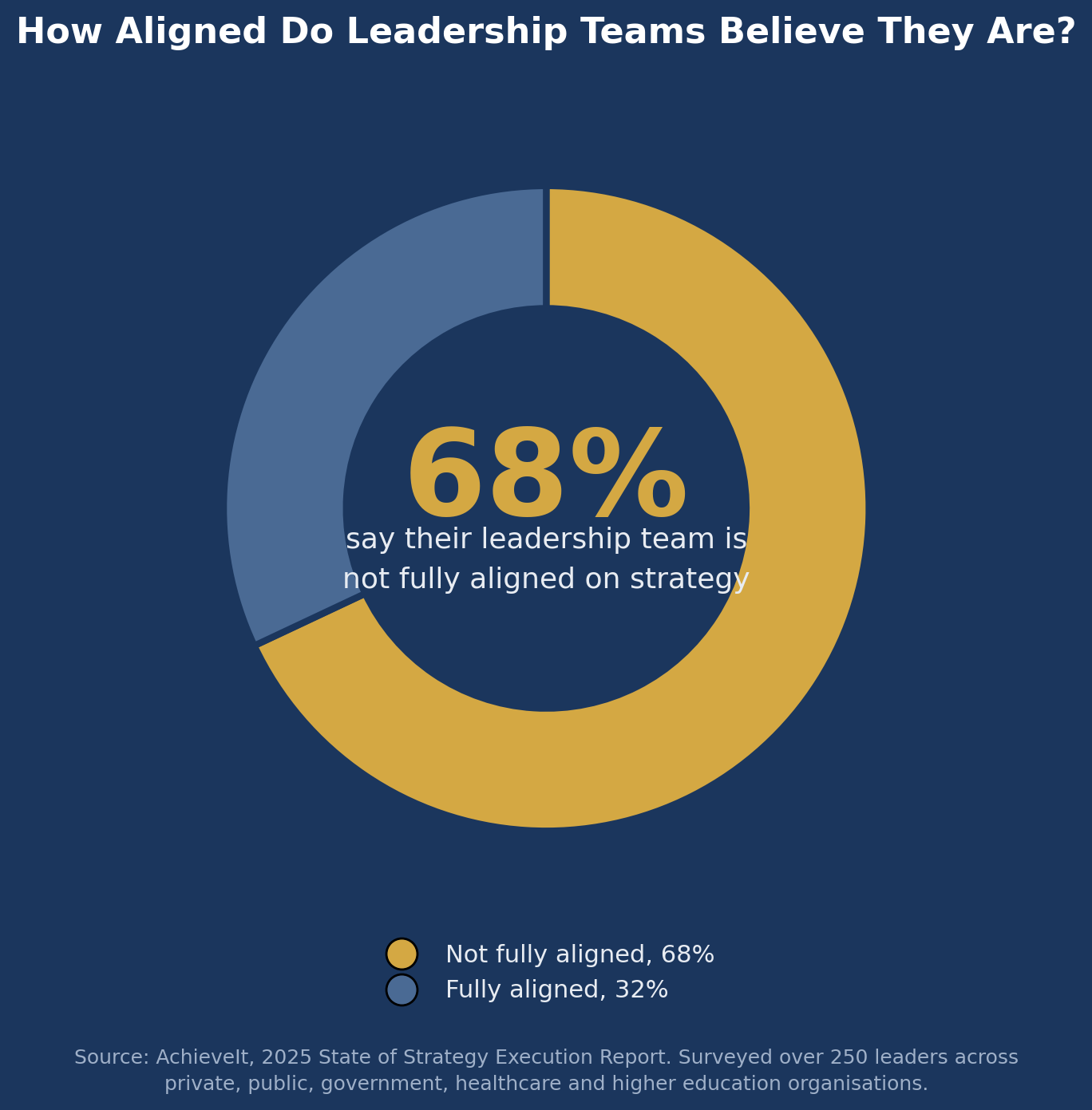
In AchieveIt's 2025 State of Strategy Execution Report, based on a survey of more than 250 leaders across private businesses, public organisations, government bodies, healthcare and higher education, 68 percent said their own team was not fully aligned with the organisation's strategic direction. Not a rival department. Not another business. Their own leadership team, the people who sit around the same table every week, looking at the same numbers, nodding at the same plan.
Most CEOs reading that statistic would say it does not describe them. Their team gets on well. Meetings end in apparent agreement. Everyone nods at the plan, closes their laptop, and walks back to their own part of the business. That is usually where the trouble actually starts, not where it ends.
Picture a fairly ordinary Monday leadership meeting. The commercial director agrees that the business needs to protect margin over volume this quarter. The operations director agrees too, genuinely, and means it. The finance director nods along, already thinking about the cash position. Everyone leaves aligned, or so it appears. Six weeks later, the commercial director is quietly chasing a large, low margin account because it will hit this month's top line number. Operations is still running the production schedule built around last quarter's volume targets, because nobody told them the emphasis had changed. Finance is building a case for a decision on capital spending that nobody else in the room remembers actually agreeing to, because in finance's version of the conversation, it was settled. Nobody disagreed in the meeting. Nobody was being difficult, evasive, or political. They simply left the room with different destinations programmed in, and each of them is now driving, competently and in good faith, toward a place the others are not going.
This is the pattern behind the AchieveIt statistic, and it is far more common in leadership teams that consider themselves close, capable and well run than most CEOs expect.
A Business Runs on More Than One Kind of Alignment
The Leadership Operating System is built on five dimensions, each covering three specific, costed gaps: Collective Intelligence, Strategic Clarity, Governance Architecture, Cultural Integrity and Financial Command. Governance Architecture tends to be the most expensive dimension to leave unaddressed, and Financial Command tends to produce the fastest tangible returns once it is addressed. But Collective Intelligence sits underneath all four of the others, because it governs whether the leadership team actually shares one working picture of the business in the first place. Get this dimension wrong, and strategy, governance, culture and financial discipline are all being built on a foundation that looks solid and is not.
Collective Intelligence covers three gaps: Gap 1, Leadership Fragmentation, which this article is about; Gap 2, Information Hoarding, where knowledge that should move freely around the leadership team instead pools in one person or one function; and Gap 3, Conflict Avoidance, where disagreements that should be resolved in the room are instead allowed to go quiet, only to resurface later as friction, delay or a decision quietly undone. All three are closely related, and a leadership team carrying one of them is often carrying at least a trace of the other two.
Gap 1: Leadership Fragmentation, Defined
Gap 1, Leadership Fragmentation, describes a leadership team that looks unified in the room and operates as several separate teams the moment they leave it, each one making sound, well reasoned, individually defensible decisions from its own private version of what matters most right now. It is not a description of people who are careless, disengaged or working against each other on purpose. In almost every case, each person involved would defend their own decision as the right one, made with the information and the priorities they believed the team had actually agreed on.
That is precisely what makes Gap 1 difficult to spot from the inside. A fragmented leadership team does not look chaotic in the way a genuinely dysfunctional one does. There is no shouting, no open conflict, no obvious breakdown. It looks, from a distance, like a team that is simply busy, each part of it working hard on something that matters. The fragmentation only becomes visible when the individual efforts are laid side by side, and it becomes clear they were never actually pulling in the same direction at all.
The GPS With Different Destinations
One way to picture Gap 1 is to imagine four experienced drivers, each given a car, each given a GPS unit, and each told, in the same room, the same sentence: "we need to get to the coast." Each driver sets off immediately, confident and competent. But because "the coast" was never pinned to a single postcode, each GPS has quietly filled in its own best guess at the destination. One driver heads for the nearest beach. Another, thinking commercially, heads for the port town with the best transport links. A third, thinking about the team's longer term ambitions, heads for the coastal city with room to grow. A fourth, cautious by nature, picks the safest and most familiar route, regardless of where it actually leads.
None of the four drivers did anything wrong. Each of them is a good driver, moving with purpose, watching the road, making sensible decisions at every junction. And yet, hours later, four cars pull up in four different towns, all technically "on the coast," and none of them where the business actually needed to be. The failure was never in the driving. It was in the destination never being pinned down together, out loud, in a form specific enough that four capable people could not quietly fill in four different answers.
"The gaps are structural. The barriers are human. The system simply never built in a step where the team checks its maps against each other before everyone drives off."
— Vijay MistriWhy This Happens, and Who Is Not to Blame
Leadership Fragmentation is not a personality clash, and in most businesses it is not a trust problem either. It is what happens by default when a leadership team has a forum for reporting information but no forum for reconciling understanding. Most leadership meetings, even good ones, are built to update each other: here is where sales stands, here is where the project is, here is the latest cash position. They are rarely built to test whether everyone in the room has actually absorbed the same working model of what the business is trying to do right now, this month, this quarter.
Each function hears the same words in the same meeting, and then, entirely in good faith, quietly translates them into its own operational language, filtered through its own pressures, its own targets and its own version of what "the plan" means in practice. A commercial director translates "protect margin" into which accounts to chase and which to let go. An operations director translates it into a production schedule. A finance director translates it into a set of numbers that need to move by a certain date. Each translation is reasonable on its own terms. Nobody ever checks whether the four translations still describe the same plan, because nothing in the system asks them to.
Three Signals Your Leadership Team Is Fragmented
Leadership Fragmentation is easiest to spot once you know what to look for. Three signals, in particular, tend to show up well before the financial cost does.
Decisions Get Relitigated
A choice that was, as far as anyone in the room remembers, made and settled in the leadership meeting resurfaces weeks later as though it had never happened. This is rarely because someone is being difficult. It usually means at least one function never actually adopted the decision as their own working priority, and has quietly been operating on their previous understanding the entire time.
Question to ask: what decision has come back to the table twice this quarter?Independent Answers Do Not Match
If you asked each of your direct reports privately, with no chance to compare notes first, what the single most important priority for the business is right now, would they give you the same answer, in roughly the same words? In a fragmented leadership team, they will not. Each answer will be defensible on its own. None of them will fully agree with the others.
Question to ask: would every answer match if you asked right now?Cross Functional Handovers Quietly Stall
A project that depends on two or more functions working together tends to move well within each function and then lose momentum exactly at the handover point. This is rarely a skills problem or a resourcing problem. It is usually because each side is quietly optimising for a slightly different definition of what "done" or "successful" actually means, and the mismatch only becomes visible once the work has to physically pass from one desk to another.
Question to ask: which handover has stalled without a clear reason?Any one of these signals on its own might be ordinary organisational friction. Two or more of them, appearing repeatedly across different projects and different quarters, is a strong indication that Gap 1 is active.
How Gap 1 Reaches Into the Rest of the Business
Leadership Fragmentation rarely stays contained to itself. Within the Seismic Map, the reference model that tracks how the 15 Gaps trigger one another, Gap 1 is a common upstream driver of four further gaps: Gap 4, Priority Overload, where too many things are treated as the top priority because the leadership team never agreed on one; Gap 5, Strategy Drift, where the business's direction slowly bends away from its stated strategy because individual functions have been quietly steering by their own version of it; Gap 7, Decision Paralysis, where decisions stall because nobody is confident the rest of the team will actually execute in the same direction once it is made; and Gap 12, Execution Decay, where plans that were agreed with real energy in the room lose momentum in the weeks that follow, because the energy was never anchored to a shared, specific destination in the first place.
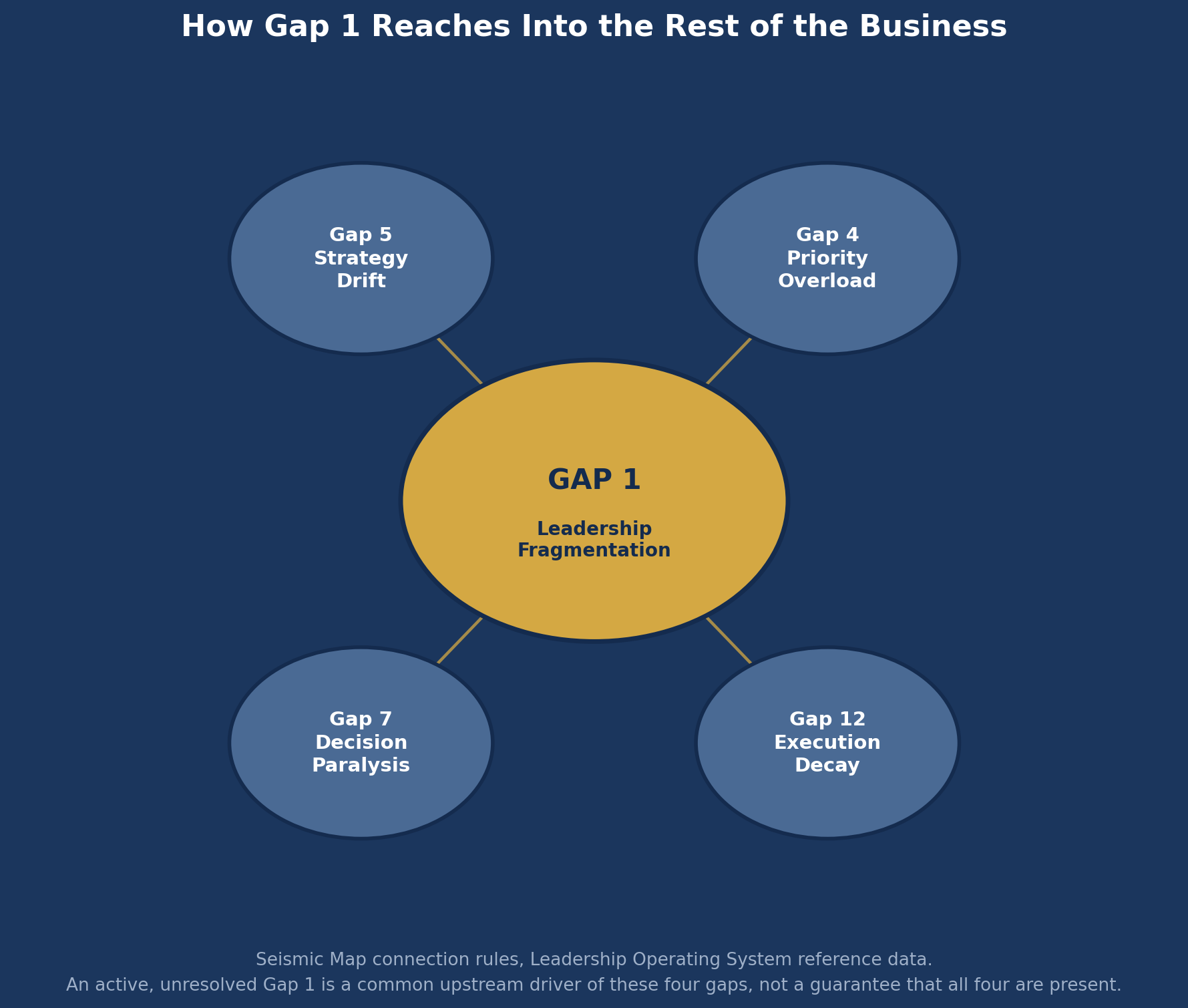
None of this means every leadership team carrying Gap 1 will also be carrying all four of these connected gaps. It means that an unresolved Gap 1 is one of the more common places these four other patterns can be traced back to, which is part of why addressing Leadership Fragmentation early tends to produce benefits well beyond Collective Intelligence itself.
What This Costs, in Practice
Consider an illustrative business, not a real client, a manufacturing company turning over around £8 million, roughly the size where the founder has stepped back from being in every conversation and the leadership team is genuinely running large parts of the business independently. Six months earlier, the team had spent a full day off site agreeing a clear growth plan: focus the next two quarters on the three highest margin product lines, and deliberately slow investment in a fourth line that had been dragging on cash. Everyone left energised. Everyone agreed.
By the time anyone looked closely again, the picture had quietly diverged. Sales had kept pursuing large orders on the deprioritised line, because it was familiar territory and the numbers looked good on paper. Production had kept the deprioritised line's tooling in near constant use to service those orders, at the cost of the capacity the other three lines needed to actually grow. Finance had been tracking overall revenue, which looked healthy, and had not flagged the shift, because nothing in the reporting distinguished "revenue" from "revenue on the lines we agreed to prioritise." Nobody had lied. Each of them had simply been driving toward their own version of "the coast."
Base range for a £3M business, £8,000 to £15,000, scaled by the standard £3M to £10M turnover band multiplier of roughly 2 to 3. Always a range, illustrative until measured against your own figures.
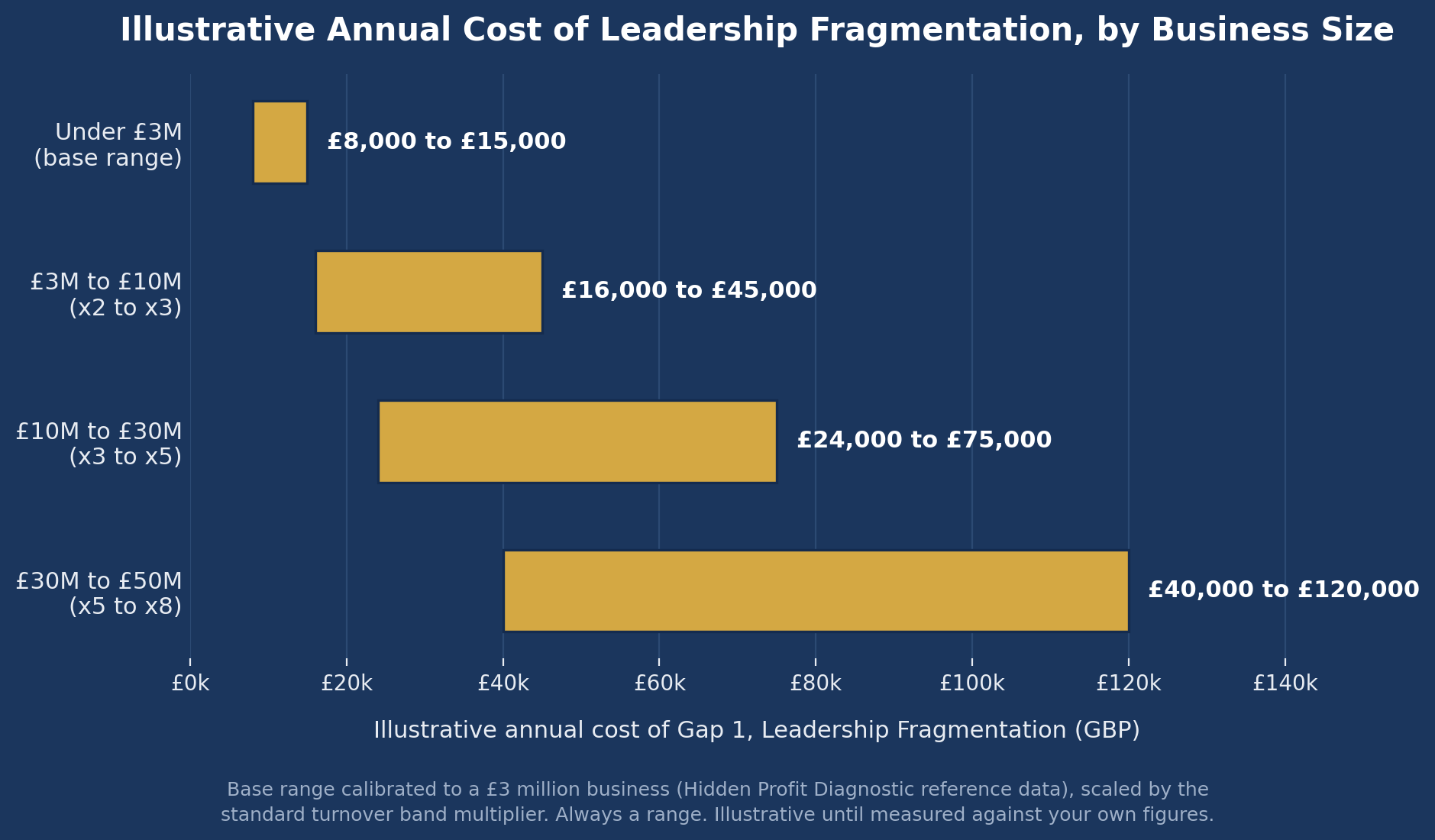
For context, the same reference data shows the combined illustrative cost of all 15 Gaps, if every one were active and unaddressed, running to roughly £90,000 to £165,000 a year for a £3 million business, and £300,000 to £500,000 a year at £10 million. Leadership Fragmentation on its own is rarely the largest single gap. What makes it worth addressing first, in many businesses, is that it is one of the four gaps feeding several of the others.
The Structural Fix
Closing Gap 1 is not primarily about having better meetings, and it is certainly not about finding people who communicate more naturally. It is about building three specific structural habits into how the leadership team already operates.
A Written, Specific Destination Statement
Not a strategy document and not a set of slides. One sentence, written down, naming the single most important priority for the business over the defined period ahead, specific enough that four capable people cannot quietly fill in four different meanings.
A Short, Recurring Reconciliation Checkpoint
Not a status update meeting, and it should not be run like one. Its only job is to test, briefly and directly, whether the actions each function has taken since the last checkpoint still point toward the same destination statement, or whether they have quietly begun to diverge.
A Visible, Low Ceremony Way to Surface Disagreement Early
Most fragmentation is not the result of an argument. It is the result of a disagreement that was never voiced at all, because nothing in the room made space for it.
None of these three habits requires new software, a consultant, or a change of personnel. They require a leadership team willing to make its shared understanding explicit, rather than assumed, on a regular basis.
The First Step, Before Your Next Leadership Meeting
Do not schedule an away day, and do not wait for the next formal strategy session. Before your next leadership meeting, ask each member of your team, independently and without comparing notes with a colleague first, to write down two short answers: what is the single most important priority for this business over the next 90 days, and what would they personally stop doing to make room for it. Then read every answer out loud in the room, in full, without softening the gaps between them.
The spread between those answers is the diagnostic. If everyone writes something close to the same thing, in close to the same words, Gap 1 is probably not active in your team right now. If they do not, and in most leadership teams who try this for the first time, they do not, you have just made the fragmentation visible in five minutes, which is the first and by some distance the hardest step toward closing it.
Where This Leaves You
If that exercise reveals more than one destination in the room, it is worth asking where else the same pattern might be quietly showing up across your leadership team, because Gap 1 rarely travels alone. The Hidden Profit Diagnostic screens all 15 gaps, including Leadership Fragmentation, across your leadership system, using 44 questions, a gap heat map, and a personal review by Vijay within 48 hours.
Frequently Asked Questions
Leadership Fragmentation, Gap 1 in the 15 Gaps Framework, describes a leadership team that agrees in meetings but operates from different, unreconciled versions of what matters most once the meeting ends. It sits within Collective Intelligence, the foundation dimension of the Leadership Operating System.
Poor communication is usually a missing message, something that was never said or never heard. Leadership Fragmentation persists even when every message has been sent and received, because the team has never had a structured way to check that everyone heard the same priority in the same way and translated it the same way into their own part of the business.
The clearest signal is disagreement discovered weeks after a decision was apparently made, not during it. A second reliable signal is asking each member of your leadership team, independently, what the current top priority is. If a fragmented team is asked this privately, the answers will differ, sometimes considerably, even though every individual believes they are working toward the agreed plan.
No. It shows up in teams of three as readily as teams of ten or more. What tends to change with size and growth is not the likelihood of the gap, but its cost, since a larger, faster growing business has more capital, more people and more commercial effort quietly moving in slightly different directions at once.
Yes, and this is one of the more counterintuitive parts of the pattern. Strong personal relationships and a genuinely positive team culture can make fragmentation harder to spot, not easier, because disagreement feels socially awkward to surface and everyone is inclined to assume good intent, which is usually correct, rather than checking whether their working understanding actually matches.
The written destination statement and the reconciliation checkpoint can be introduced within a single leadership meeting. Most teams notice a measurable reduction in relitigated decisions and stalled handovers within the first one or two cycles of using them, well before any change shows up in the annual numbers.