
I have already made the case, in an earlier piece on this site, that AI does not create weakness in an organisation. It exposes what was already there, at speed. That argument still holds, and if you have not read it, it is worth doing first: AI Is Not A Technology Challenge. It Is A Leadership Operating System Challenge. Everything below builds on it rather than repeating it.
What I want to do here is go one level deeper. If AI genuinely just exposes and amplifies whatever leadership operating system it is placed inside, there ought to be one measurable thing inside that system that predicts, better than anything else, whether a business gets a return on its AI spend. There is. It is decision velocity, the speed and independence with which your leadership team can move a decision from raised to resolved. Almost nobody is tracking it, and the evidence now backing that up is stronger than it was even a few months ago.
What the 2026 Evidence Actually Shows
PwC's 29th Global CEO Survey, covering over four thousand four hundred chief executives across ninety five countries, found that fewer than a quarter of CEOs report AI applied extensively across their core activities, and most reported no meaningful revenue gain or cost reduction from it in the past year. Nearly forty per cent went further, saying their company will not be viable in ten years if it stays on its current path.
Separate research from West Monroe, reported by CIO, found that seventy four per cent of leaders lose up to five per cent of annual revenue to slow decision making. IBM's own research puts the same idea even more directly: eighty three per cent of global CEOs now believe AI success depends more on adoption and decision making than on the technology itself.
Three independent sources, three different research methodologies, one recurring pattern. That is worth taking seriously precisely because it keeps showing up in more than one place. A pattern is not proof on its own, it is a hypothesis worth testing. Is it recurring rather than a one off? Yes. Is there an alternative explanation, perhaps the tools themselves are simply not good enough yet? Possibly, in places, but that does not explain why some businesses using the same generation of tools are seeing real returns while others are not. What is the cost of waiting? At up to five per cent of annual revenue, for many CEOs reading this, that is not a rounding error.
Why the Bottleneck Moves to the Leadership Team
AI does not respect the org chart. It moves horizontally, touching finance, operations, sales and delivery at the same time, because that is how the underlying data and workflows actually connect. Most leadership teams, however, were built for an era when decisions moved the other way, sequentially, function by function, with each person signing off in turn before the next person even sees the question.
Accelerate the front line without redesigning that structure and you do not get a faster business. You get a business that produces answers faster than its leadership team can absorb them, discuss them, and decide what to do about them. The bottleneck simply moves. It used to sit with the person doing the work. Now it sits with the people meant to be leading it. This is the Governance Architecture dimension of the Leadership Operating System, the decision rights and meeting discipline that determine whether a team can move at the pace its own information now allows.
Reporting drawing on Conference Board research, covering large organisations attempting AI led change, has identified three specific ways this shows up in practice. Functional leaders protect their own domain rather than optimise for the whole business, so a decision that should take an afternoon waits for four separate sign offs. Information reaching the top team has already been shaped and filtered before anyone at the table sees it raw, so the leadership team is deciding on a curated version of reality rather than the thing itself. And consensus becomes a polite form of avoidance, a settled decision gets quietly reopened in the corridor afterwards because nobody was willing to own it in the room. None of these three require new technology to fix. They require a leadership team willing to look honestly at its own habits.
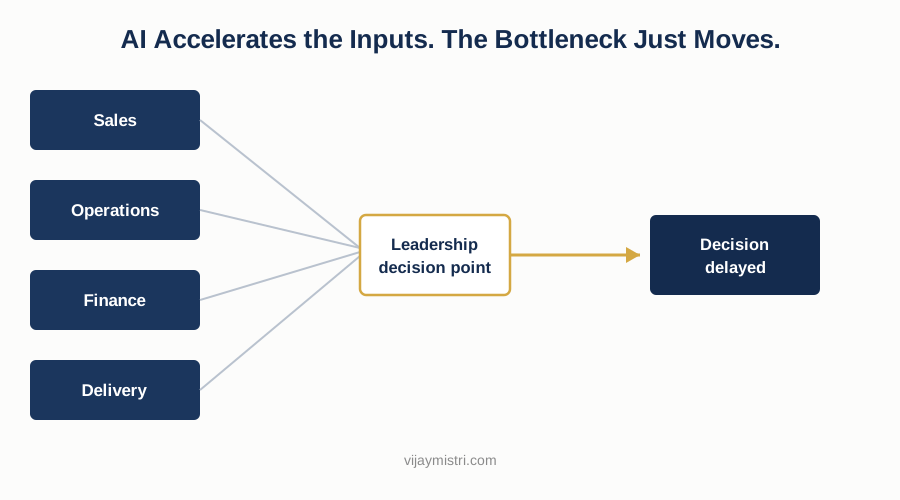
AI accelerates the inputs from every function at once. Without redesigning decision rights, the bottleneck simply relocates to the leadership team.
What Decision Velocity Looks Like When It Is Fixed
In one leadership team I worked with, decision dependence on the chief executive, meaning the proportion of meaningful decisions that could not move without that one person personally in the room, fell from around eighty three per cent to under fifteen per cent within ninety days. Decision speed on the same category of decisions moved from around six weeks to under three days. Nothing about the underlying talent in that business changed in ninety days. What changed was who was authorised to decide what, how information reached the table, and whether a decision, once made, was allowed to stand rather than be quietly reopened afterwards.
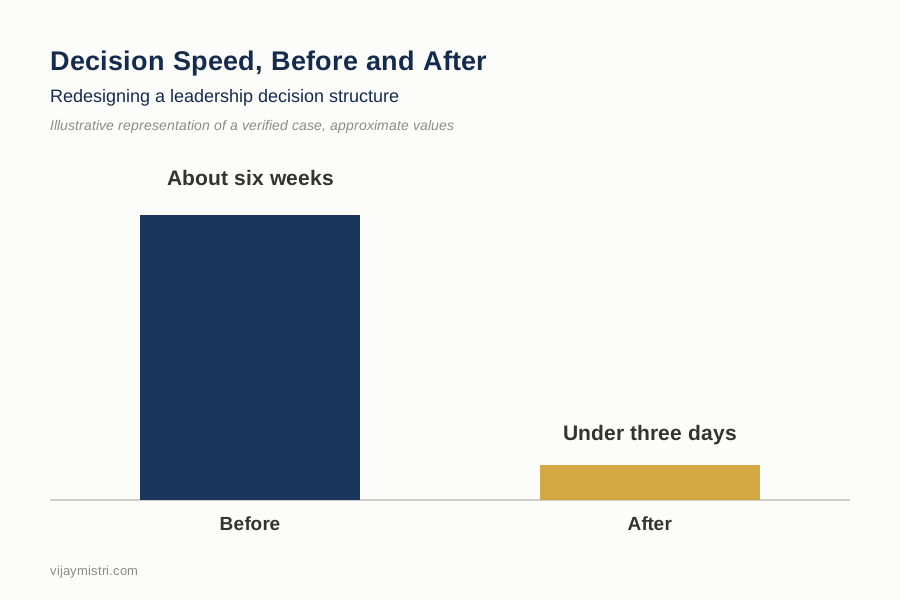
Illustrative representation of a verified case. Approximate values.
AI enables. It can surface a pattern, draft an option, model a scenario in minutes rather than weeks. But it is human intelligence, structured properly, that decides what to do with what AI surfaces, and amplifies it into an actual result. Buy the tool without fixing the structure, and you simply generate more unresolved options, faster, for a leadership team that already could not keep pace with the ones it had.
"AI enables. Human intelligence amplifies. Buy the tool without fixing the decision structure and you simply generate more unresolved options, faster."
— Vijay Mistri, Leadership Operating System ArchitectThree Questions Worth Asking Your Leadership Team This Week
You do not need a full diagnostic to start finding out whether this applies to you, though a proper one will go a great deal further.
- 1 Take the last five genuinely important decisions your leadership team faced. How many of them could only move forward once you personally were in the room? If the honest answer is most of them, you have a concentration problem, not a talent problem, and it will only get more expensive as AI increases the flow of decisions arriving at your door.
- 2 Ask how information actually reaches your top team. Is it raw, or has it already been shaped, softened and pre agreed before it gets to you? A leadership team fed only curated conclusions cannot make fast, sound decisions, however capable each individual in the room is.
- 3 Look honestly at how often a decision, once made, gets quietly reopened. Begin with the ending in mind. If your team cannot commit to a decision and let it stand, no amount of AI generated analysis will speed anything up, because the bottleneck was never analysis in the first place.
The gaps are structural. The barriers are human. I fix both.
None of this is a criticism of any individual leader. Most leadership teams were built well for the world they were built in. The structural gap is a decision architecture that was never redesigned for a business now capable of producing answers far faster than it used to. The human barrier sitting alongside it is usually a reluctance to let go of a decision once it has been personally shaped, or to trust a team to decide without checking back first. Both are fixable, and fixing the structural side tends to move faster than most leadership teams expect once the human conversation happens alongside it.
Knowledge is getting the right answers, and AI is now extremely good at that part. Intelligence is asking the right questions, deciding what those answers mean, and having the courage to act on them. That part is still, and will remain, entirely yours.