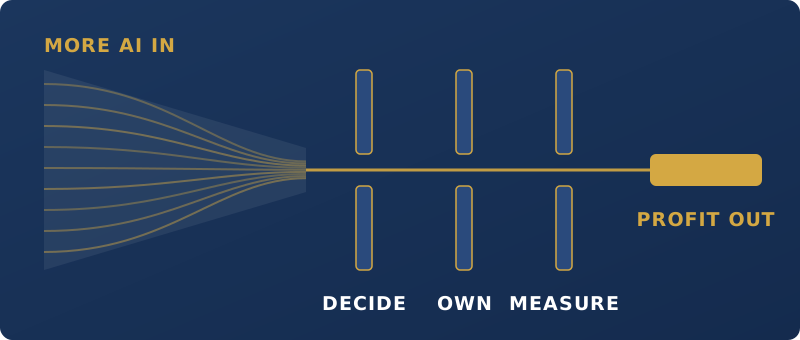
AI makes output cheaper. It does not make profit automatic. Profit appears only when someone decides what to do with the time and capacity AI frees up, owns the result, and measures it in money. Most businesses have adopted AI widely, and in my experience few have built those three things, which goes a long way towards explaining why so many CEOs report no financial return. The fix sits in the leadership operating system, not in another tool.
Picture the board meeting. The CEO reports that AI is now used in marketing, finance, customer service and operations. The directors nod. Then one of them asks a simple question: "Which line of the profit and loss account has that moved, and by how much?"
Someone mentions hours saved. Someone else mentions a pilot that went well. Nobody can name a figure in pounds.
Try it with your own leadership team. First, how many AI tools is the business using? Second, which line of the profit and loss account has each one moved? The first answer comes quickly. The second usually does not.
That gap between the two answers is where the profit goes missing. And it is not a small gap.
Why is AI not making businesses more profitable?
Start with the evidence, because it is more consistent than the headlines suggest.
PwC's 29th Global CEO Survey asked 4,454 chief executives in 95 countries and territories, between 30 September and 10 November 2025, what AI had done for their business. A majority, 56 percent, reported neither higher revenue nor lower costs. Only 12 percent reported both. (PwC)
Adoption is not the problem. The Office for National Statistics estimates that about 35 percent of UK businesses with ten or more employees were using AI in June 2026, almost three times the figure of about 12 percent in September 2023. But depth has barely moved. The average adopting business uses about 1.6 AI technologies, up from about 1.4, and only 10 percent of those using AI describe their use as extensive. (ONS)

Wide adoption, shallow use, and a financial return for a small minority. Sources: ONS and PwC, as cited above.
Inside organisations the picture is similar. Gallup's workplace data for US employees shows 52 percent using AI at work at least a few times a year by May 2026, yet only 25 percent saying their organisation has communicated a clear AI plan or strategy. (Gallup)
Put those together and most CEOs will recognise the pattern. Plenty of activity. Plenty of enthusiasm. A great deal of perceived productivity. And very little that anyone could point to in the accounts.
The figures above are survey findings: what businesses, employees and executives reported. They show adoption, perception and reported outcomes. They do not prove why profit is missing. The explanation that follows, decide, own, measure, is my interpretation, drawn from my diagnostic work with leadership teams.
Researchers have noticed it too. A March 2026 NBER working paper, based on a survey of nearly 750 corporate executives, found that perceived productivity gains run ahead of measured ones, which the authors suggest probably reflects a delay in revenue realisation. (NBER) A delay is a fair reading. But in my experience, a delay with nobody owning it has a habit of becoming permanent.
WATCH: Why More Technology Doesn't Automatically Mean Better Business Performance
In this video I explain why AI does not remove dysfunction inside a leadership team but exposes and speeds it up, and why the starting point is the operating system underneath the technology, not the tool on top of it. It is a useful companion to the numbers above.
Video published 28 May 2026. It loads from YouTube only when you select play.
What happens to the time AI saves?
Here is the mechanism as I see it, and it is simpler than it sounds.
AI makes certain kinds of work faster and cheaper: drafting, summarising, analysing, preparing, searching. That is real, and I am not arguing otherwise. But time saved is not profit. It is capacity. Capacity becomes profit only when something changes as a result: a cost comes out, a hire is avoided, more revenue work gets done, or an error is prevented.
Whether any of those happens depends on three things that AI cannot do for you.
1. Decide: what will the freed time be used for?
When a task that took four hours now takes one, somebody has to decide where the other three go. If nobody does, they dissolve into the working week, spread thinly across dozens of people in pieces too small to redeploy.
This is the old problem of decisions taking too long, in a new form. In a West Monroe survey of 1,214 executives and managers at large US companies, 73 percent estimated that their organisation loses up to 5 percent of annual revenue to slow decision making and delayed execution. (West Monroe) Those firms are larger than most of my readers' businesses, so treat the figure as a signal, not a benchmark.
The signal matters because AI generates drafts, options and analysis faster than most leadership teams are used to receiving them. If the decision process has not changed, the new speed simply queues behind the same few people. I look at that queue in The Half Life of a Decision and Decision Velocity. And if too much still depends on you, AI does not cure that. It feeds it. The full version of that problem is in The CEO Bottleneck.
2. Own: who is accountable for the result, not the tool?
Most AI tools have an owner, usually IT or whoever championed them. Very few AI results do. Ask who is accountable for the saving or gain the tool was bought to deliver. If the honest answer is "nobody, it was a pilot", you have found the problem.
Gallup's finding that only a quarter of employees say their organisation has communicated a clear AI plan is the same issue seen from the shop floor. If people cannot say what AI is for, nobody can be held to what it delivers. It is the familiar gap where nobody really owns the result, which I describe in Why Good Companies Keep Missing the Same Deadlines.
3. Measure: can you see the money?
Even when a benefit exists, many businesses cannot see it. Time saved is rarely baselined, so there is nothing to compare against. The cost of AI appears on one line of the accounts, while the benefit, if it arrives, is scattered across many. This is the old problem of not being able to see where the money is going, and AI makes it worse because it adds a cost line while spreading the benefit thin. The numbers that tend to be missing are in The 5 Numbers Your Finance Director Cannot Answer.
If you would like a quick first view of how your own business stands on decisions, ownership and visibility of the numbers, the free Boardroom Profit Diagnostic V2 takes about four minutes and asks 15 short questions.
What does this cost? A worked illustration
The assumptions below are mine, chosen to be plausible and simple. Change them to match your own business.
Take a £15m business with 60 office based people. Each costs about £45,000 a year in salary and employment costs, which is about £27 an hour across 1,650 productive hours. Suppose AI tools costing £30 per person per month release three hours a week each, for 46 weeks of the year.
That is 8,280 hours, or about five full time equivalents. Valued at cost, that capacity is worth roughly £225,000. The tools cost £21,600 a year. On paper, that looks like ten times the cost. But the £225,000 is theoretical capacity value. It is not profit, and it does not appear in the accounts. Four different things are easily confused here:
- Theoretical capacity value. Hours released, priced at cost. It is a potential, not a result.
- Genuine cost savings. Money that actually stops leaving the business, such as overtime, agency or contractor spend, or a leaver not replaced.
- Avoided recruitment. A planned and budgeted hire that is no longer needed. It counts only if the hire would genuinely have happened.
- Incremental profit contribution. Extra gross profit earned because freed time went into revenue work. That is the margin on the extra sales, not the cost of the hours.
| What leadership did | Illustrative annual profit impact before tax | On £15m turnover |
|---|---|---|
| Nothing changed. The time was absorbed into the working week. The £225,000 of capacity value was never realised. | (£21,600) | (0.1) points of margin |
| Two hires avoided, assumed to have been genuinely planned and budgeted: £90,000 of avoided recruitment cost, less tools. | £68,400 | 0.5 points of margin |
| As above, plus one equivalent redeployed to selling and evidenced at £250,000 of extra sales at a 30 percent gross margin: £75,000 of incremental gross profit contribution. | £143,400 | 1.0 points of margin |
Brackets show a loss. Every figure is an assumption, not a client result, and all are before tax. The avoided hires are a comparison against the planned cost base, not necessarily a reduction in current reported expenditure. The last two rows count only benefit that can be evidenced, and ignore commission and other costs of earning the extra sales. Even the best case leaves about two of the five equivalents unconverted, which is why unassigned capacity is the real risk.
The tools were identical in all three cases. The difference was entirely leadership: what was decided, who owned it, and whether anyone measured it. That is also why a business can spend more on AI every year and still see no change in margin. The spend is visible. The conversion is a management act.
If this feels familiar, it is a close cousin of the problem I describe in Revenue Is Growing. So Where Is the Profit? In both, the benefit is real but something in the operating system consumes it before it reaches the bottom line.
What would a high performing CEO team do differently?
PwC's report is useful here. The one in eight CEOs seeing both higher revenue and lower costs were not simply using better tools. The report says they were furthest ahead in building foundations: a clear AI roadmap, formal responsible AI and risk processes, a technology environment that enables integration, and a culture that supports adoption.
In the language of my leadership operating system, a roadmap is Strategic Clarity, risk processes and decision rights are Governance Architecture, and a supportive culture is Cultural Integrity. The fourth dimension, Financial Command, is what turns the other three into profit, because it is the ability to see the money. None of these is a technology question.
In my experience, three behaviours tend to separate the businesses that convert from those that do not:
- They treat every AI use as a business case with an owner, not an experiment that runs indefinitely.
- They decide in advance what freed capacity is for, instead of discovering months later that it has gone.
- They review AI in money at the leadership table, not in logins, licences and usage statistics.
For the wider readiness view, my earlier article, AI Is Not A Technology Challenge. It Is A Leadership Operating System Challenge, sets out seven pillars a CEO should assess before investing further.
Five questions to ask before the next AI tool is approved
You do not need a project to start. Put these five questions to every AI tool you already pay for, and to every new one before it is approved.

Five questions. If any answer is blank, the benefit is probably going to be absorbed.
The five questions in detail
This week: list the AI tools you already pay for and put one name against the result each was bought to deliver. If several lines stay blank, you have your starting point.
Where I am coming from
As Group Finance and Commercial Director, I was part of the executive leadership team during a period in which the business group achieved approximately 20 fold revenue growth over nine years.
In a separate manufacturing engagement, I served as a board adviser and company coach, working alongside the leadership team during a period in which profits increased approximately fourfold within two years.
Since then I have coached and consulted over 100 CEOs and executives on the structural reasons good intentions do not always reach the accounts.
My view on AI is simple. AI enables. Human intelligence amplifies. The gaps are structural. The barriers are human. Sustainable improvement has to address both.
The strategic point
AI is a multiplier. It multiplies whatever your leadership operating system already does well, and whatever it does badly. A business that decides slowly will now have more to decide slowly about. A business where nobody owns results will now have more results nobody owns.
The next competitive advantage will not come from another AI tool. It will come from the business that turns freed capacity into decisions, owners and numbers faster than its competitors.
Vijay MistriClarity first. IMPACT fast.
Your next profit improvement may already be inside your business.
If you lead a business with a leadership team of three or more, the free Boardroom Profit Diagnostic V2 is a sensible first step. Answer 15 questions and see your score out of 100, your main issues in plain English and one move to make this week.
Discover Your Hidden Profit GapsFree. 15 questions, about four minutes. A short details form comes before your results. No obligation.
Frequently Asked Questions
Sources and further reading
The worked illustration is arithmetic with stated assumptions, not a client result. External evidence:
- PwC, 29th Global CEO Survey, 2026. 4,454 CEOs in 95 countries and territories, surveyed 30 September to 10 November 2025.
- Office for National Statistics, Artificial intelligence in UK businesses: 2023 to 2026, published 20 July 2026. Business Insights and Conditions Survey, wave 159.
- Gallup, Global Indicator: Artificial Intelligence. US employees, figures as of May 2026.
- Baslandze et al., Artificial Intelligence, Productivity, and the Workforce: Evidence from Corporate Executives, NBER Working Paper 34984, March 2026.
- West Monroe, Slow decisions are costing companies millions, 27 January 2026. 214 C suite executives and 1,000 managers at US companies with at least $250 million in revenue.